LoRA training
Train an LTX-2.5 LoRA locally
LTX-2.5 is Lightricks' 22B open-weights video model, and it generates a soundtrack alongside the picture. Inline Studio trains LoRAs for it on your own GPU, on video clips rather than still frames, in two shapes: a Clip LoRA that learns look and motion together, and a Control LoRA that learns a transform from paired reference and target clips. Both train the picture, not the sound. Training runs against the dev transformer, and the adapter then loads on all three LTX nodes.
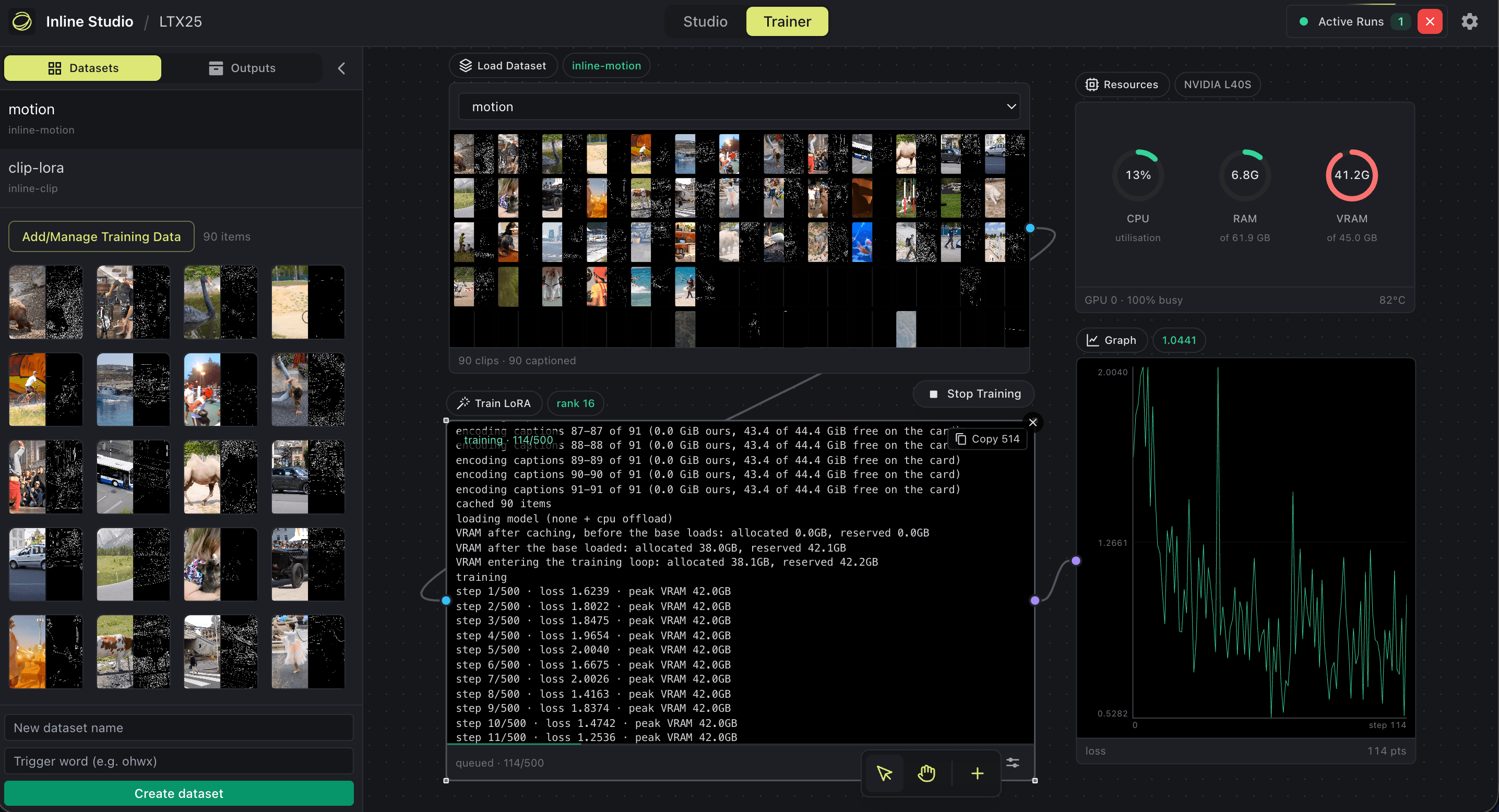
A Control LoRA run on 90 paired clips. Every tile is one training item: the clip on the left, the edge map it learns to follow on the right.
Which base to train on
Pick the architecture in the Trainer's Adjust panel, then a base within it. Training directly on a step-distilled checkpoint breaks the distillation down, so every architecture offers a way around that.
Dev transformer (required)
Lightricks publish the dev build beside the distilled one specifically so it can be trained. It is the only base the trainer accepts. The adapter you get out loads in both fast and quality mode, because they are the same architecture.
Clip LoRA or Control LoRA
A Clip LoRA learns from single clips: look, style and motion together. A Control LoRA learns a transform, so it needs a reference clip paired with every target and conditions on the reference while training. Both adapt the same video attention and feed-forward layers, and neither touches the audio branch, so a trained adapter changes the picture and leaves the soundtrack to the base model.
What the trainer needs on disk: ltx-2.5-22b-dev-transformer-bf16.safetensors (42GB). Nothing is downloaded behind your back, and a run that is missing a file stops and names it.
LTX-2.5 LoRA training VRAM, measured
Peak allocation at 12 steps, rank 16, batch 1, with gradient checkpointing on. The number is torch.cuda.max_memory_allocated, so leave headroom for the CUDA context and allocator slack.
| Configuration | L40S (46GB) | L4 (24GB) | RTX PRO 4500 (32GB) | T4 (15GB) |
|---|---|---|---|---|
| Clip LoRA, 512px, rank 16 | ~42GB | not measured | not measured | Not supported |
Measured on an L40S: the 22B base alone is 38GB once loaded, and training peaks at 42GB. There is no 4-bit path to fall back on here, because LTX loads through its own builder and takes no quantization config, so a 48GB card is the floor rather than a comfort. A 24GB card cannot run this at any resolution. The T4 column is blank because LTX needs Ampere or newer, not because the number is missing.
See the full matrix in the README, or compare all three architectures.
The dataset
Add clips or images from this machine, a folder, or a Hugging Face repo. Captions are read from a dataset.json or metadata.jsonl if the set ships one, and anything without a prompt can be captioned locally before it lands.
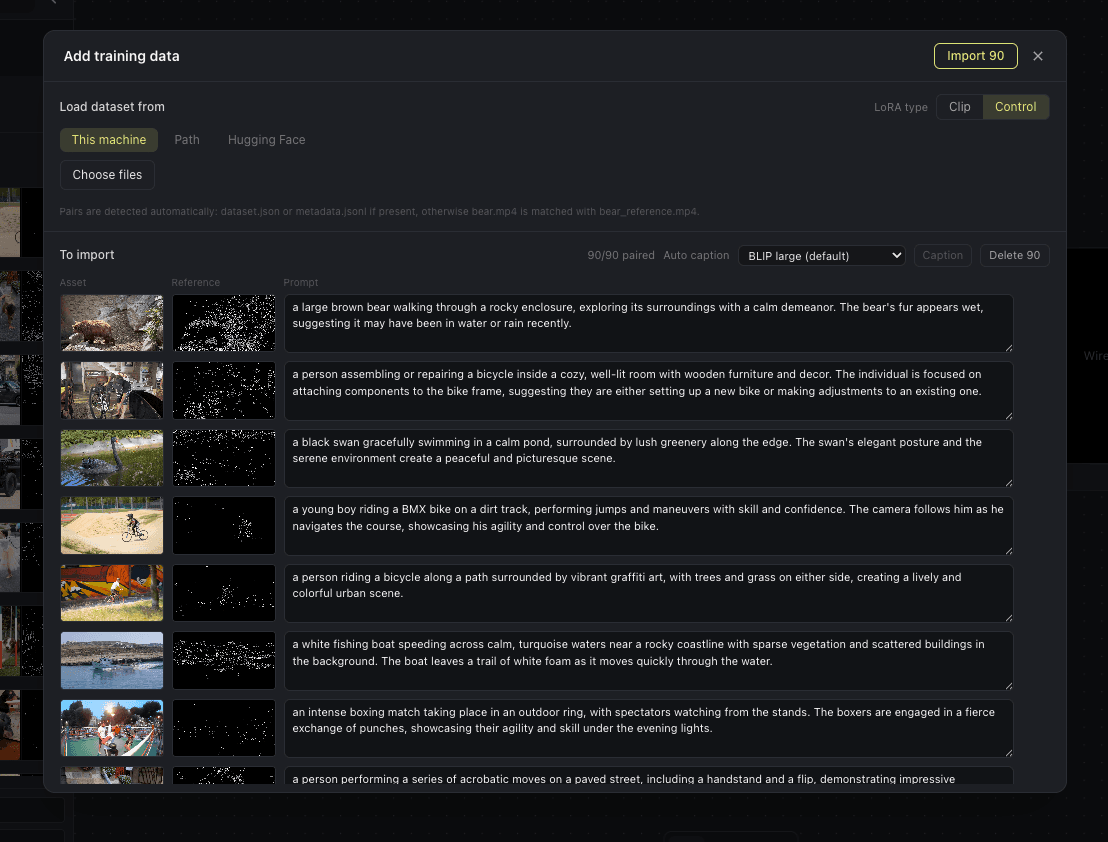
A Control LoRA dataset. Every row is a pair, so the editor carries a Reference column the clip-mode one does not, and the counter reads how many are matched.
What a Motion LoRA dataset looks like
A Control LoRA learns a transform, so every item is two clips: a reference that carries the structure and a target that carries the result. These pairs come from Lightricks' Canny Control dataset, where the reference is an edge map of the target. Train on pairs like these and the adapter learns to follow an edge map at generation time. The pair has to line up frame for frame, since the two are trimmed to the same length rather than checked against each other.
Lightricks document how to build one, including compute_reference.py for deriving references from clips you already have: the LTX-2 dataset preparation guide.
An example dataset
Lightricks' own IC-LoRA set: 90 clips, each paired with an edge map of itself, and a dataset.json carrying the captions and the pairing. It is the shortest route to a working Control LoRA, because you can see immediately whether the adapter learned to follow an edge map. Paste the repo id into the Hugging Face tab and the Trainer reads the pairing itself, so nothing needs renaming first.
Lightricks/Canny-Control-DatasetHow long a run takes
- About 0.67s a step at 512px on an L40S, measured over 50-step windows. The startup is the expensive part rather than the step: encoding 25 short clips and loading the base takes around 13 minutes, so a 300-step run spends more time getting ready than training. The encode is cached and reused, so prefer long runs.
LTX-2.5 LoRA training FAQ
What GPU do I need to train an LTX-2.5 LoRA?
48GB. Training peaks at 42GB on an L40S, and the 22B base alone is 38GB once loaded, so a 24GB card such as an L4 cannot run it at any resolution. There is no 4-bit path to shrink it: LTX loads through its own builder, which takes no quantization config. Generation is a different question and much more forgiving, because LTX streams its own weights and can run from system RAM or from disk, so a card too small to train on can still render.
What is the difference between a Clip LoRA and a Control LoRA?
A Clip LoRA learns what your clips look like and how they move, from single clips. A Control LoRA learns the transform between two clips, so every dataset item needs a reference as well as a target, and the pair should agree on frame count: both halves are trimmed to the same length, so a mismatched pair trains misaligned rather than being rejected. Lightricks call the second one an IC-LoRA.
Why does my clip length change when I type it?
The video decoder only encodes certain frame counts, 8n+1 at 24fps for LTX-2.5, and the trainer snaps down onto that grid because a clip does not have frames the file never held. The panel shows what your setting actually resolves to next to the field, so it is never a surprise.
Does the LoRA work with the fast distilled model?
Yes. You train against the dev transformer, but distilled and dev are the same architecture, so the adapter loads in fast mode too. Every LTX node has a LoRA input.
Do I need to accept a licence first?
Yes. The weights are gated on Hugging Face. Open the model page, accept the LTX-2 Community License, and make sure the account you accepted with is the one your token belongs to, or every download comes back as a permission error.
Licence
The LTX-2.5 weights are published by Lightricks under the LTX-2 Community License, and the repo is gated: accept the terms on Hugging Face with the same account your token belongs to, or every download returns a permission error. Inline Studio is GPL-3.0 and does not change those terms. A LoRA you train is your own file, but running it still means running the base model under its licence, so read it before you ship anything commercial. LTX-2 Community License.
Train your first LTX-2.5 LoRA
Free and open source. Runs on macOS, Windows, and Linux.